
Blog
A Building Manager’s Checklist for Reducing HVAC Energy Costs in Singapore

Table of Contents
Key Takeaways
- HVAC systems account for 40 to 60 percent of a commercial building’s total energy use in Singapore, making them the highest-impact area for reducing HVAC energy costs.
- Singapore’s MEI regime now requires buildings in the bottom 25 percent for EUI to reduce energy consumption by at least 10 percent. Benchmarking against BCA’s published data is the place to start.
- Duct leakage, rooftop heat gain, and airflow imbalance are the most overlooked sources of HVAC energy waste, and all are fixable without replacing core equipment.
- Chiller sequencing, Variable Speed Drives, and routine maintenance like tube cleaning and sensor calibration deliver the highest returns at the lowest cost.
- The Energy Efficiency Grant (EEG) offers up to S$350,000 for qualifying upgrades, and BCA’s GMIS-EB 2.0 co-funds green certification retrofits for existing buildings with a GFA of at least 5,000 sqm.
Your electricity bill often reveals HVAC inefficiencies before maintenance reports do. According to the NCCS Air-Con System Efficiency Primer, ACMV systems account for 40 to 60 percent of a commercial building’s total energy use in Singapore’s climate. That makes HVAC energy saving one of the most effective ways to reduce operating costs.
Most building managers are already doing the basics, like filter changes, scheduled servicing, set-point monitoring. But the biggest savings don’t come from those.
This guide explores the strategies that go beyond standard maintenance and can deliver more significant efficiency gains.
What Singapore’s 80-80-80 Targets Mean for Your HVAC Strategy
BCA’s Singapore Green Building Masterplan sets out the “80-80-80 by 2030” targets:
- To green 80% of Singapore’s buildings by GFA
- Have 80% of new developments by GFA meet Super Low Energy standards from 2030
- Achieve an 80% improvement in energy efficiency from 2005 levels for best-in-class green buildings
As of December 2025, close to 66% of Singapore’s buildings had been greened.
For building owners and facilities teams, this makes HVAC performance a practical priority, not just a sustainability goal. Under the Mandatory Energy Improvement regime, energy-intensive buildings with GFA of 5,000 m² or more may be required to conduct an energy audit, submit an Energy Efficiency Improvement Plan, and implement measures to reduce energy consumption by 10% from the building’s average EUI over the three years before the MEI (Mandatory Energy Improvement) notice.
If your building has not been benchmarked against BCA’s published energy performance data, that is a useful starting point.
How HVAC Drives Your EUI Score
Energy Use Intensity, or EUI, measures a building’s annual electricity use against its gross floor area. It is one way BCA assesses building energy performance.
HVAC energy efficiency in Singapore has a major impact on EUI because cooling demand is high year-round. A typical air-conditioning system’s energy load is roughly:
- 55% from the chiller
- 35% from fans
- 10% from pumps and cooling towers
The chiller is usually the biggest energy-saving lever. However, fan energy from AHUs, ductwork, and air distribution also matters, especially when poor airflow or duct leakage makes the system work harder
Checklist 1: Conduct a Baseline HVAC Energy Audit
Know Your EUI, and What It’s Telling You
Every building energy audit in Singapore starts with EUI with the formula: EUI = Total Annual Electricity (kWh) ÷ Gross Floor Area (m²)
BCA benchmarks show 2023 medians of 164 kWh/m² for pure offices, 255 for hotels, and 447 for retail (NUS IREUS / BCA). Pull three years of bills and plot the trend. A rising EUI with stable occupancy means something is degrading.
Find the Problem Areas Before They Find You
EUI tells you there’s a problem. Zone-level analysis tells you where. Watch for persistent temperature complaints, AHUs running longer than occupancy justifies, and chiller runtimes climbing without rising demand. Chillers not upgraded since 2010 may be well below current BCA Green Mark HVAC standards.
Track monthly:
- Chiller kW/RT, EUI year-on-year
- AHU temperature differentials
- Chilled water delta-T
- Equipment runtime trends
Checklist 2: Seal and Insulate Your Duct System
Warning Signs You Have a Duct Leakage Problem
Duct leakage quietly inflates your energy bills without showing up as an obvious fault. Watch for:
- Uneven cooling across floors
- Unexpectedly high chiller runtime
- Unusual static pressure readings
- Condensation on exposed ductwork in plant rooms
If your ductwork is more than 15 years old and has never been assessed, significant losses are likely. A professional duct sealing service will start with a full diagnostic assessment before any remediation work begins.
Inside-Out Duct Sealing: How the Technology Works
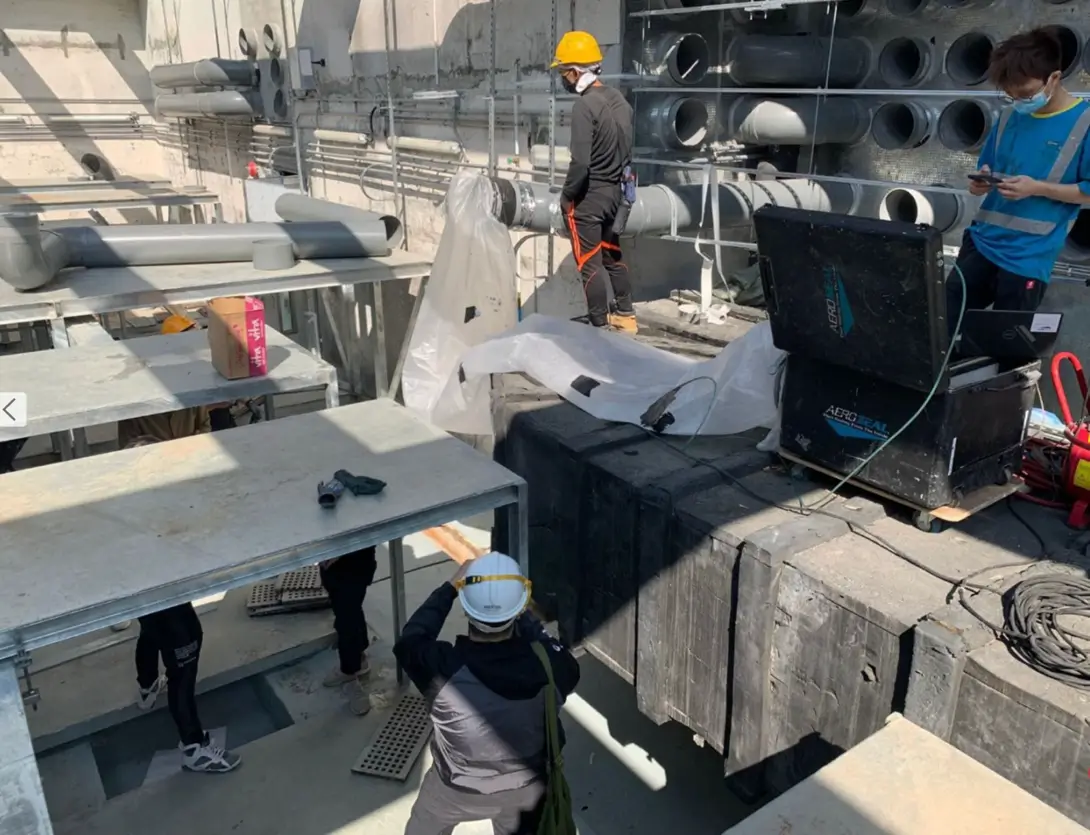
Traditional duct sealing often requires access to each joint, which can mean opened ceilings, added labour, and disruption to daily operations. Inside-out duct sealing avoids this by sealing leaks from within the duct system.
Our Aeroseal Duct Sealing process works by:
- Pressurising the duct system to locate air leakage.
- Releasing a non-toxic aerosol sealant into the airstream.
- Allowing the sealant particles to move through the ductwork.
- Sealing gaps only where air is escaping, without coating the full duct surface.
- Tracking leakage reduction in real time.
- Issuing a verified certificate once sealing is complete.
The sealant contains no VOCs, leaves no residue, and helps keep disruption low. This technology has been used in Grade-A offices, medical centres, science parks, shopping malls, and commercial complexes. You can explore duct sealing options for buildings in Singapore.
Don’t Overlook Duct Insulation
Uninsulated supply ducts in warm ceiling plenums absorb heat en route, arriving warmer than intended and making your chiller compensate. Treat degraded or moisture-saturated insulation as an energy efficiency measure. Check vapour barriers, too. A compromised barrier causes humid air to condense inside the insulation, reducing thermal resistance and encouraging mould.
Checklist 3: Apply Cool Roof Coatings to Reduce Heat Gain at the Source
How Rooftop Heat Gain Drives Up Cooling Loads in Singapore
In Singapore, rooftop heat can quickly increase cooling demand. On a clear day, a conventional concrete roof can exceed 60°C. Research published in Elsevier’s peer-reviewed journal Renewable Energy found that, under Singapore conditions, a cool coating with solar reflectance of 0.74 reduced peak concrete roof temperature by up to 14.1°C. It also determined that indoor air temperature by 2.4°C, and daily heat gain through the roof by 54%.
Humidity makes the issue worse by keeping roof surfaces hotter for longer, including after sunset. Moisture can also weaken roof insulation, reducing its thermal performance. For facilities teams, cool roof coatings help reduce heat at the source, improve HVAC efficiency, and support better indoor comfort.
Selecting the Right Cool Roof Coating for Tropical Conditions
Look for products specifying solar reflectance (minimum 0.65, ASTM C1549) and thermal emittance (minimum 0.80, ASTM C1371). In Singapore’s climate, emittance matters as much as reflectance, a coating that reflects well but emits poorly will still allow heat to build up in the substrate. Standard reflective coatings address the first problem.
More advanced heat dissipating paint addresses both, actively converting absorbed heat into kinetic energy rather than allowing it to accumulate. This keeps surfaces cooler even after peak sunlight hours. Also, prioritise flexibility, as the country’s thermal cycling, rainfall, and UV exposure will crack a rigid coating over time.
How to Measure Solar Reflectance Performance After Application
Manufacturer-stated reflectance values are laboratory measurements. What’s important is how the coating performs on your actual roof, and that degrades over time.
Here’s how to track it:
- Right after application, measure in-situ reflectance using a portable solar reflectometer (complying with ASTM C1549) directly on the roof surface. This gives you a verified baseline to compare against in future checks.
- Re-measure every 12 months. In Singapore’s climate, soiling from tropical rainfall and biological growth degrades reflectance faster than in temperate regions. Annual checks catch losses before they become significant.
- Don’t wait two or three years between measurements. By then, you may have been running a significantly degraded coating without knowing it, and your chiller has been compensating the entire time.
- When readings fall below your specified minimum reflectance, schedule re-coating before the next wet season, not after.
Checklist 4: Balance Airflow to Eliminate Overcooling and Energy Waste
Why Air Balancing Matters and What It Costs You When It’s Wrong
Air balancing adjusts airflow so each zone gets exactly what its heat load requires. Overcooled zones waste chiller energy while undercooled zones push occupants to lower setpoints, raising system-wide demand. Imbalanced airflow also increases fan static pressure and worsens humidity control.
In Singapore, an overcooled zone drawing in humid air from an unconditioned space creates a continuous loop, cooling and dehumidifying air that keeps getting replaced by outdoor-condition air. It’s not a set-and-forget task: occupancy shifts, layouts change, equipment gets added, and a system balanced at commissioning will drift.
Checklist 5: Optimize Your Chiller Plant and ACMV System Performance
The chiller is central to ACMV system energy efficiency. Chiller plant efficiency in Singapore is commonly measured in kW/RT, or the electricity needed to produce one refrigeration tonne of cooling. Since chillers often run at part load, IPLV usually gives a better view of real-world performance than full-load COP.
Efficiency can improve through proper chiller sequencing, BMS reprogramming, and Variable Speed Drives on fans and pumps. A 20% speed reduction can cut power demand by roughly half. Key maintenance tasks include chiller tube cleaning, condenser coil cleaning, and annual sensor calibration, as scale buildup or a faulty sensor can quietly increase energy use.
Checklist 6: Monitor, Benchmark, and Stay Accountable to Your Energy Targets
The biggest gap in energy management is often not data, but visibility. A simple daily dashboard is more useful than a detailed platform that is only checked once a month.
Track five metrics:
- Chiller kW/RT
- EUI year-on-year
- AHU temperature differentials
- Chilled water delta-T
- Equipment runtime trends
Set alerts when readings move outside acceptable limits, and translate monthly efficiency results into cost impact. For example, a chiller slipping from 0.70 to 0.82 kW/RT is easier to act on when the added cost is clear. Benchmark performance against BCA’s Building Energy Benchmarking Reports, and use Green Mark criteria as an internal standard.
Reducing HVAC energy costs
Effective commercial building energy saving in Singapore is not a single fix, but a structured process. Start with an audit, then identify where energy is being lost through duct leakage, rooftop heat gain, airflow imbalance, or chiller inefficiency. From there, the right improvements can be prioritised, implemented, and monitored to keep performance on track.
To explore duct sealing, cool roof coatings, or any of the solutions covered in this guide, get in touch with Delta Sirius.
FAQs
Are there government grants or incentives available for HVAC energy efficiency improvements in Singapore?
Yes. The Energy Efficiency Grant (EEG) from Enterprise Singapore co-funds energy-efficient equipment, EEG (Base) up to S$30,000 per company, EEG (Advanced) up to S$350,000. The Base tier application window has been extended to 31 March 2028. BCA’s Green Mark Incentive Scheme for Existing Buildings 2.0 (GMIS-EB 2.0) separately supports green certification retrofits for privately-owned buildings with a GFA of at least 5,000 sqm.
What is the difference between a Green Mark audit and the MEI building energy audit in Singapore?
A Green Mark audit is voluntary and covers multiple sustainability dimensions, including energy, water, indoor environment quality. The MEI audit, mandatory from September 2024 for buildings in the bottom 25 percent for EUI, focuses solely on energy performance and requires a binding improvement plan targeting at least 10 percent EUI reduction. Passing one doesn’t satisfy the other.
How does Singapore’s humidity affect HVAC energy consumption compared to other countries?
Singapore’s humidity, typically 70 to 90 percent year-round, means HVAC systems must remove moisture on top of cooling the air. That latent load is why HVAC energy here can hit 60 percent of total building consumption, versus 40 to 50 percent in drier climates.
Can older commercial buildings retrofit their HVAC systems to meet current BCA energy standards?
Yes, and many already have. Options range from BMS adjustments and VSD installations to full chiller replacements. The MEI regime’s EEIP only requires a 10 percent EUI reduction from pre-audit levels, for most buildings in the bottom quartile, that saving is already there waiting to be found.